Saturday, October 16, 2010

And the winner is...

Heather!

Congratulations! You're going to MISS ABIGAIL'S GUIDE TO DATING, MATING, AND MARRIAGE!

Sunday, September 26, 2010

MISS ABIGAIL'S GUIDE TO DATING, MATING, AND MARRIAGE


It's the story


Of a babe named Abby


Who is hooking up nice boys


With lovely girls.


She has blonde hair,


Like the old TV show;


(She's not the one with curls).


It's the story


of a chick named Leslie


Who was once a single actress in New York;


But in her novel,


TEMPORARY INSANITY,


the boyfriend was a dork.


So, it all began when the lovely Jennifer of Miss Abigail's Guide to Dating, Mating & Marriage contacted me out of the blue and told me that she and her sister are huge fans of my novel TEMPORARY INSANITY. Who knew? Then she made me an offer I couldn't refuse...


ANNOUNCING A CONTEST!
Win a pair of tickets to an Off-Broadway show and an autographed copy of one of my novels!

The clever folks who have brought MISS ABIGAIL to Off-Broadway and I have teamed up; and one of my blog readers will win a voucher for a free pair of tickets to the show!


Not only that, the lucky winner will also receive an autographed copy of one of my novels about dating, mating, and marriage ... titled HERSELF.


The MISS ABIGAIL voucher is valid for Thursday and Friday performances at 8pm; Wed. matinees at 2pm; Saturday performances at 2pm and 5pm; and Sunday performances at 3pm and 7:30pm. The voucher expires on November 28, 2010.


MISS ABIGAIL'S GUIDE... is performed at Sofia's Downstairs Theater, 221 West 46th St. , NYC., right in the heart of the theater district.


The contest is open until October 15, 2010 at midnight, in order to give the winner ample time to redeem his or her voucher. Yes, you are responsible for getting yourself to NYC!


To enter: please submit your name and an email address where I can contact you. I will be contacting the winner to get your snail mail address to send you the ticket voucher and your autographed. book. To add to the fun, when you post your entry, tell me who you'd bring as your guest to MISS ABIGAIL'S GUIDE TO DATING, MATING, & MARRIAGE -- and why! :)


If you become a follower of this blog, or already are a follower, you get an additional chance. If you tweet about the contest, you get an additional entry, and if you post about it on Facebook, you get an additional chance as well!


Good luck to all!!

Wednesday, August 18, 2010

Leslie Carroll's interview on NPR's TRAVEL WITH RICK STEVES


The marvelous and engaging Rick Steves, travel guru extraordinare, interviewed me in March 2010 about traveling in the footsteps of famous royals. It was a marvelous opportunity to discuss my 2010 nonfiction release, NOTORIOUS ROYAL MARRIAGES, and thanks to the broadcast, my book sales have skyrocketed.


The interview aired in mid-August 2010.


Here's the link to the interview. Please note that via the magic of Mr. Steves' editing, my segment is preceded, quite serendipitously, by an interview with Elizabeth Gilbert, author of EAT, PRAY, LOVE, which was adapted into a major (and just released) motion picture, starring Julia Roberts.


Leslie Carroll's interview on Rick Steves' travel program on NPR:
http://www.ricksteves.com/radio/streaming/program216.asx with the extras, including a discussion of Princess Diana, at http://www.ricksteves.com/radio/archive.htm#216.


Enjoy -- and may you be tempted to hop on the next plane for your favorite palace!

Sunday, May 2, 2010

BY A LADY the subject of academic discourse? What Would Jane Say?


Every author I know can't resist the temptation to Google herself from time to time. And if she says she doesn't, chances are she's either shading the truth or has a core of steel.


As Oscar Wilde famously said, "the only way to get rid of temptation is to yield to it. I can resist anything but temptation." But this reaction often exacts a price. Sometimes, we're not so thrilled with what we find online when we search our names or book titles. Other times we're delighted -- for example, when we find terrific reviews posted by book bloggers we had heretofore not known about.


And sometimes we're confused, bemused, and amused, or some mash-up of all three emotions.


An old friend recently emailed me to ask if I knew that my novel BY A LADY: Being the Adventures of an Enlightened American in Jane Austen's England (written under the pen name Amanda Elyot), was mentioned in the new nonfiction book by Claire Harman, JANE'S FAME. Harman's title says it all. And my book merits a mention from Ms. Harman among the crop of novels inspired by Austen's writing, or her very existence.


A subsequent Google search of my book title revealed that it is also the subject of discussion in a Spring 2010 article by Juliette Wells included in Persuasions online, the web version of the academic house organ published by the venerable Jane Austen Society of North America. The topic is Jane as a fictional character.


Few people know the lengthy and often fraught trajectory my manuscript took from conception to publication, so it feels rather odd (a) that the novel, or even I as an author, carries the sort of weight that makes it worthy for academic discussion; and (b) that a scholar can dissect what I had intended as a literary romp, absent deliberate social commentary on the life and works of my favorite author and attribute to it concepts or intentions that, well, had not occured to the author herself.


This author, I mean. Not Jane. Yet all I could think when I read Ms. Wells's essay (did she choose to include BY A LADY because my heroine's surname is Welles?) is What Would Jane Think? Because this sort of scholarly analysis is precisely what we do with Austen's own work. Or Shakespeare's for that matter. Or any number of famous (and, often, mostly dead) writers.

Please don't imagine that I think for even a nanosecond, that I deserve to be in the hallowed pantheon inhabited by the likes of Austen and Shakespeare. Or that I am in any way knocking Ms. Wells's intriguing essay. I was just gobsmacked to find my novel discussed as part of an academic topic in such a rarefied forum as the JASNA world stage. Ditto for the mention in Ms. Harman's well reviewed study of Jane's evergreen allure.


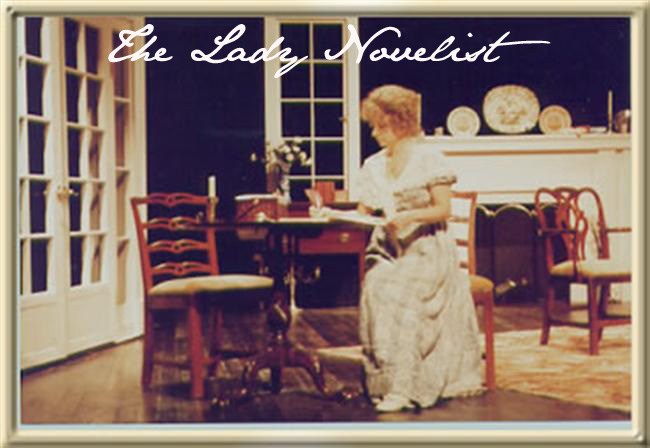
BY A LADY was born from an experience I had performing the role of Jane Austen in a beautiful two-character drama written by Howard Fast, a prolific novelist himself. I was so inspired by Fast's script, and the set and costume design of our production that I could not help thinking "what if" I were to be transported back in time to Jane's era. The photograph that forms this blog's banner is of me, playing Jane.


The very notion of writing a time-travel (and I began to write the manuscript way ahead of the Jane-Austen-as-a-meta-character-curve in late 1998, finishing it in the early months of 1999) in itself (so I believe, anyway) telegraphs to the reader that because we are in an alternate universe, that universe is intended to be a fairly fun place to inhabit as a reader, even if it is not exactly a walk in the park for my heroine).

I had researched the era, manners, mores, fashions, etc., but the tip of my tongue (though not all of it) was in my cheek. My original title, SENSE AND SENSUALITY, supported that premise. I was having a lark and hoped that readers would enjoy the novel in a spirit of fun. This is precisely why I'm sort of tickled to find BY A LADY analyzed for the author's motivations and intentions as though it was MANSFIELD PARK.

Nowadays, I could throw in a few zombies, sea monsters, and werewolves and probably waltz all the way to the bank (or at least the bookstores) with it. But because my manuscript was mining new literary territory at the time, it took half a dozen years for BY A LADY to reach the shelves. My stellar agent Irene Goodman submitted it to numerous editors, all of whom rejected it for various reasons, most of which had to do with the fact that they didn't know where a major bookstore chain would shelve it, and therefore, how the publishing house should market it.

The process began a dozen years ago; we were way ahead of the Jane as a fictional (though supporting) character/time travel curve. Editors would ask: Is this a romance? Is this historical fiction? Is this a paranormal? Before they would consider publication, a few editors requested rewrites from me, the better to fit it into a more specific niche. The manuscript went through myriad incarnations as I twisted myself into a pretzel to give them what they'd asked for.

My favorite rejection letter came from one of the business's top romance editors, someone I admired (and still admire and adore). Ironically, a few years later we ended up working together in a different fictional genre. But her rejection letter contained the sort of sentence that authors always remember: she wrote something along the lines of "this has the most sensuous love scene I have ever read..." Then she wrote that they nonetheless had to reject the manuscript because they didn't know what to do with it.

My response? The little voice that remained inside my head replied, "Publish it!"


In any case, what ultimately became BY A LADY was a romance and a paranormal (time-travel) and a work of historical fiction. And the road to publication widened several years later when the meta-Austen curve that I had been traversing began to resemble a straightaway, with other referential novels pouring over publishers' transoms.


So I just thought I'd share the backstory of BY A LADY, in case people are curious, after reading any of the recent references to the novel online or in print. It still feels truly weird to me to find my little literary volume a subject of scholarly analysis. I have to say, I'm strangely flattered to have been invited to the party even if the hostess may not be entirely sure what I'm wearing.

Has anyone else been the subject of an academic discussion? I'd love to hear your reaction to it.

P.S. Amanda is available for interviews.
Wednesday, February 24, 2010

The Land of Misfit Toys


I've always rooted for the underdog. My heart melts into a puddle at the sight (or even the mention) of something someone else derides. If it's a team, I'm inclined to support it. If it's a toy, I'll surely want to hug it. If it's a book, I'll likely want to read it.


And I can never get through an annual viewing of the yuletide television perennial "Rudolph the Red-Nosed Reindeer" without wanting to adopt every single one of the playthings that have been deemed (by society? Santa Claus?) "misfits."


So, as the calendar says we're closer to Valentines Day or St. Paddy's than Christmas, why do I have Rudolph's plastic and furry pals on the brain?

Spring Cleaning (and that phrase always makes me think of another classic -- James Barrie's Peter Pan) is coming early to my house. We're doing a major de-clutterfying and I am discovering things I haven't used, or even seen, for years, and forgot I owned. That qualification would seem to make the item destined for either the scrap heap or the thrift shop.


I have no problem consigning my husband's area rugs to that category, but when I come across an old and beloved childhood toy -- the long-since-bald doll, the one with now-wonky legs, or the stuffed animal that has so many patches it's hard for a civilian to tell what species it once represented, a current interpretation of a "misfit toy," I can't imagine doing anything but wanting to love it.


So, as we're about to stare down another blizzard here in NYC, I raise my iced coffee glass to Spring Cleaning and the re-discovery of Misfit Toys. You gotta love 'em.


Monday, January 11, 2010

THE HARLOT'S PROGRESS: A Mottley Crew of Vibrant Characters


My own book research offers me scant opportunities for pleasure reading these days, but I knew that THE HARLOT'S PROGRESS was a novel that wouldn't wait for my schedule. My hunch was correct. It's a triple whammy in my wheelhouse: historical fiction, the 18th century, and the Theatre; and I can't remember the last time I could not bear to put a novel down.


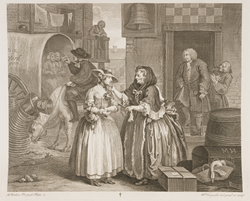
Innocence is lost; retribution won. Worlds collide with noisy bursts of energy in the late Peter Mottley's novel, THE HARLOT'S PROGRESS, the first in a trilogy loosely based on the series of paintings titled "A Harlot's Progress," painted by William Hogarth in 1731.


Hogarth's Moll Hackabout is transformed into "Yorkshire Molly" Huckerby, who arrives in London intending to meet her cousin, a magistrate, with the hope of marrying him. But when the York Wagon dumps her outside The Bell, what she is led to believe is a coaching inn for weary wayfarers, she is seduced by The Bell's bawd, Mrs. Wickham, and subsequently ravished by the evil Colonel Charnell. With her stolen maidenhead went her reputation. Thrust into the life of a destitute, demoralized and debauched harlot, Molly embarks on a series of unexpected adventures belied by Mottley's classic set-up of country lass thrust into a life of vice upon her first visit to the big city.


Mottley is a master at world building, with an uncanny ear for period dialogue. His pages teem with sensuality, from the odors of ordure and vomit to the perfumed periwigs of playgoers. Sweat mingles with saliva in the haze of candlelight. His London is a place of heavy velvets, cheap cottons, gossamer thin lace and linen, the topography of a heavily embroidered cuff.

His heroes and heroines are the disenfranchised -- those who society does not permit to speak up, for whom justice is denied, those who the "quality" gentry has either forgotten or despised (or both): harlots, blacks, children, Jews.

His villains are society's sacred cows -- the military, the clergy, and the judiciary. But in THE HARLOT'S PROGRESS, we are shown the underbellies of the beasts; their dark side: corruption; vice; hypocrisy.

Peter Mottley was a playwright, actor, and director and employs his theatrical experiences and background to great advantage here. He doesn't miss the chance to incorporate specific play titles and glimpses at life backstage (including a running gag involving a pair of actors desperate to finish fornicating before their cue). In one scene the rutting leading man complains at having to play Macheath in John Gay's "The Beggars Opera" because he thinks it will ruin his reputation. It's another allusion of Mottley's, an inside joke in our theatre world: "Satire is what closes on Saturday night."

Other aficionados of classical theatre, particularly the plays of Shakespeare, Vanbrugh, and Gay, may see certain scenes coming a mile away; I'm thinking of one in particular. I'd correctly surmised what was about to happen, and yet Mottley sufficiently builds the tension, as well as our sympathy for the right characters, that you find yourself drawn in, fingers shielding your eyes as you peep through them at the scene you knew would take place, but dread watching.

Yes, there are a few implausible elements within the novel: for an early 18th century Yorkshire farm girl Molly is awfully well educated (she's familiar with the story of Leda and the Swan -- yet [as might be expected] has never heard of Tarquin and Lucrece). Colonel Charnell's wife was an heiress when she married him (for love), admitting that he had only been a captain at the time. Yet seventeenth- and eighteenth-century marriages were financial arrangements, and unless she'd managed to get pregnant out of wedlock, her father would never have allowed such a marriage to take place. Lavish gowns are stitched up in less than a day. In truth, the turnaround time at best might have been a few days, with the modiste's entire staff hard at work on the creations.

But these are quibbles. And most readers wouldn't even know that Mottley had cut a few corners. Better to focus on the quirks he gives his characters: a hunchbacked Jewish moneylender has more humanity than most people in London; a childlike harlot who routinely adopts the names of Shakespearean heroines, dreams of a stage career (astute readers would grasp the unexpressed irony here: actors were considered no better than harlots in that era!)

If only Mottley had lived to see THE HARLOT'S PROGRESS published. But his daughter, Jocelyn Pulley, to whom the novel is dedicated, has recorded a book trailer http://www.youtube.com/watch?v=cSF5bsCCDJg with such tremendous expressiveness and gusto that you'll be panting for your copy to arrive in the mail!

This is not your candy-colored Georgian novel. THE HARLOT'S PROGRESS: Yorkshire Molly is properly bawdy and sordid, gritty, grimy, violent and vibrant -- yet ultimately, incandescently, hopeful.

Tuesday, December 29, 2009

Guest Interview: Christine Trent and THE QUEEN'S DOLLMAKER


I’m so happy to welcome historical fiction author Christine Trent, whose debut novel THE QUEEN’S DOLLMAKER, is being released today, December 29. What a wonderful way to start the new year!


On the brink of revolution, with a tide of hate turned against the decadent royal court, France is in turmoil - as is the life of one young woman forced to leave her beloved Paris. After a fire destroys her home and family, Claudette Laurent is struggling to survive in London. But one precious gift remains: her talent for creating exquisite dolls that Marie Antoinette, the Queen of France herself, cherishes. When the Queen requests a meeting, Claudette seizes the opportunity to promote her business, and to return home. Amid the violence and unrest, Claudette befriends the Queen, who bears no resemblance to the figurehead rapidly becoming the scapegoat of the Revolution. But when Claudette herself is lured into a web of deadly political intrigue, it becomes clear that friendship with France’s most despised woman has grim consequences. Now, overshadowed by the spectre of Madame Guillotine, the Queen's dollmaker will face the ultimate test.


THE QUEEN’S DOLLMAKER is set during the era of the French Revolution. How did you become interested in this time period? What you love about it?

I’ve always been interested in French and English history, but the period of the French Revolution is just so full of political upheaval and the destruction of centuries of royal rule that it’s easy to become totally absorbed in the era. I can’t imagine the turmoil the average citizen must have experienced. Also, as much as Marie Antoinette has been vilified over time, I think it’s difficult to do a thorough study of her life and not begin to feel a bit of sympathy – if not outright respect – for her. Given her spoiled and pampered upbringing, she really demonstrated nerves of steel when her world began falling apart. I find the period simply fascinating.


What do you like least about this period? Anything that constrained you or that you had to plot carefully around?

The mass killings were simply appalling, particularly because they were so indiscriminate. If your neighbor was jealous of you, he might report you as harboring royalist feelings, and that pretty much ensured prison time, if not a visit to the guillotine. Robespierre thought that everyone would support his idea of “purification through bloodshed,” when in reality, people just wanted food because they were hungry. In terms of careful plotting, I tried to ensure that Claudette’s adventures with Marie Antoinette very closely tracked to the day-to-day historical record in the days surrounding the queen’s imprisonment and subsequent execution.

Did you have to do any major research for this book? Did you stumble across anything really interesting that you didn’t already know?

I’d love to be able to say that I traveled to Paris and Versailles for research, but, alas, instead I was forced to rely on my memory of a trip I took many years ago. I also surrounded myself with lots of biographies on Marie Antoinette, and they exist aplenty. Prior to researching, I had no idea that Count Axel Fersen made a trip to England, and he quite took the country by storm. Fortunately for my storyline, I really needed Fersen in England to meet my dollmaker, so it was one of those “Aha!” moments where fact met fiction in a very neat intersection.

What sparked this book? Was it a character? An historical event? A scene you just couldn’t get out of your head?

In 2003, I had just finished reading Antonia Fraser’s MARIE ANTOINETTE: THE JOURNEY, and was also in the process of weeding through my doll collection (and somehow I never parted with a single doll). Turning the book over in my mind as I was handling all of my precious babies, I remembered that Marie Antoinette enjoyed dolls and frequently sent them to her mother and sister. It occurred to me that there was a nugget of an original story in the queen’s dolls, one that had never been explored before. I finished the manuscript in 2006 and sold it in 2008. So thoughts of the late French queen have literally been swirling around in my head for years.

Please share a bit about your writing process. Are you a pantser or a plotter? Do you write multiple drafts or clean up as you go?

I am a 100% plotter. I greatly admire novelists who can sit down and write, “It was a dark and stormy night,” and let the story go where it will. I typically develop a ten-page synopsis detailing the entire storyline and work from there. Sometimes I’ll make some plot changes once the story is underway, but I usually stick pretty close to that synopsis. As a result, I tend to type up a first draft without cleaning as I go, then doing multiple reads to make corrections.

Please tell us about your background, and what led you to become a novelist.

My husband says it was a “no-brainer” for me to write books, because I’ve been collecting them for so long. The poor man spends most of his spare time building me bookshelves. I started out writing as a bit of lark (“Hey, wouldn’t it be fun to write a book?”). It only got serious when page followed page and all of a sudden three years later I had a finished book. That’s when I realized the next step was to try and sell it. I was fortunate to be picked up by Audrey LaFehr at Kensington Publishing.

What/Who do you like to read? And are you one of those authors who tends to avoid reading the same genre you’re currently writing in during the in-progress stages of your own novel?

No way. I love historical fiction and I can’t read enough of it. Writing full-time makes it tougher to get as much reading done as I’d like, but I’ve always got a big pile of historical novels on my nightstand. Waiting for me right now are Michelle Moran’s CLEOPATRA’S DAUGHTER, Lauren Willig’s MASQUE OF THE BLACK TULIP (I’m way behind on Lauren), C.S. Harris’ WHAT REMAINS OF HEAVEN, and Hilary Mantel’s WOLF HALL. I just finished up Harris’ four previous St. Cyr mysteries, as well as Philippa Gregory’s THE WHITE QUEEN. All excellent books. There’s more in my to-be-read pile (including, of course, Leslie Carroll’s NOTORIOUS ROYAL MARRIAGES as research for future novels), but we probably don’t have enough space to list them all.
What are you planning to work on next?

I just wrapped up a sequel, tentatively titled THE WAX APPRENTICE. It follows the adventures of Marguerite Ashby under her apprenticeship to the great waxworker Madame Tussaud. It’s a swashbuckling tale brimming with historical figures, political intrigues, and a heroine determined to live life on her own terms. THE WAX APPRENTICE should be at your local bookstore in early 2011.

I hope your readers will visit http://www.christinetrent.com/ for more information about my books.

THE QUEEN’S DOLLMAKER is available at the following online locations, as well as your local bookstore:

Amazon.com http://www.amazon.com/Queens-Dollmaker-Christine-Trent/dp/0758238576/ref=sr_1_1?ie=UTF8&s=books&qid=1248305592&sr=8-1
Barnes and Noble.com http://search.barnesandnoble.com/The-Queens-Dollmaker/Christine-Trent/e/9780758238573/?itm=1&USRI=the+queen%27s+dollmaker
Borders.com http://www.borders.com/online/store/TitleDetail?sku=0758238576#complete_contributors
Books-a-Million.com
http://www.booksamillion.com/product/9780758238573?id=4266846562070

Indiebound.org http://www.indiebound.org/book/9780758238573